
I build The things that needed to exist
Usually because no one else did. Sometimes because the org moved on before it was finished. Always because the gap was too obvious to ignore.


About Me
I'm Bianca Zongrone Jefferson: a UX, research, and product operations leader with 10+ years of building design practices, research programs, and operational infrastructure inside product organizations that were moving fast and needed someone to make the speed sustainable.
I run Maebean LLC out of Omaha, Nebraska, where I take on fractional engagements, consulting projects, and the occasional "how did this internal tool get this bad" cleanup sprint. I also teach design thinking to undergraduates, which keeps me honest about what actually matters and what's just jargon.
The long version of how I got here
My academic background is in human resource development and industrial-organizational psychology, which means I've always understood design as a people problem first, a systems problem second, and a craft problem third. I came up in UX through user research, not visual design. I know how organizations work, how teams break down, and why the thing that looked good in Figma still failed in production.
Early in my career I co-founded a Girls Who Code chapter through the Omaha Public Library, which eventually became Mystery Code Society — an independent 501(c)(3) focused on getting women and girls into tech. That work wasn't a side project; it was the foundation. It taught me that the most important design work is often the work that makes space for people who weren't in the room when the original decisions got made.
I've spent my career building the thing that should have been there already.
Research programs at companies that were shipping without talking to users. Design systems at orgs where accessibility was an afterthought. Discovery rituals at product teams where "we know our users" meant "we haven't tested anything in six months." Operations infrastructure that turned chaos into something repeatable.
The through-line isn't any one methodology. It's the willingness to look at a gap, figure out what's actually needed, and build it, even when that means convincing twelve stakeholders it was their idea.
Who I do my best work with
I've worked across construction tech, agriculture, sports technology, managed hosting, cybersecurity compliance, and education nonprofits. The industry matters less than the posture: teams that are serious about their users, willing to question their assumptions, and not looking for someone to just execute tickets.
I have a soft spot, and I'm not going to pretend I don't. I love working with nonprofits, women-owned businesses, and women-founded startups. The organizations doing the most interesting work with the most creative constraints tend to be the ones that weren't built by the usual suspects. That's where I want to show up.
→ Series A–C B2B SaaS teams who are scaling faster than their design and research infrastructure can keep up
→ Nonprofits and mission-driven orgs that need senior UX or web presence work without a full-time hire
→ Women-founded and women-owned businesses at any stage; this is where I started, and it's still where I do some of my most meaningful work
→ Product teams navigating AI adoption who want to actually embed it into how they work, not just talk about it on a roadmap
→ Small businesses and local orgs that need a website that actually works and someone to keep it that way
The receipts
10+ years. Multiple orgs. Zero interest in padding a bio with buzzwords. Here's what the work actually looked like:
→ Led UX and research at CompanyCam through growth from $34M to $100M ARR; built the research program from scratch, redesigned core workflows, drove a 13% lift in user engagement and retention
→ Drove AI feature acceleration from 1 beta release to 4+ launches per month in six months by embedding discovery rituals and fixing release rhythms
→ Researched and designed an internal tool at Hudl that saved over 1,000 billing support hours
→ Brought a design system back into WCAG compliance at WP Engine, then documented it so it stayed that way
→ Grew design teams from 2 → 12; built the hiring, critique, and career frameworks to go with it
→ Built the Avenue Scholars website from scratch using Elementor and maintain it on retainer
→ Co-founded Mystery Code Society (formerly Girls Who Code Omaha), an independent 501(c)(3) focused on women and girls in tech
EDUCATION
MBA, Boston University · HCI Certificate, Georgia Tech · MS Human Resource Development, Villanova · BS Business and Management, RPI
CERTIFICATIONS
CSPO, Scrum Alliance · Pragmatic Management Level III
CURRENTLY TEACHING
Problem Solving & Design Thinking · Nebraska Wesleyan University
BASED IN
Omaha, Nebraska · Available remotely, always

Not a beep boop consultant
I teach design thinking to undergraduates, which means I spend part of my week reminding 20-year-olds that "I don't know yet" is a valid and often correct answer. It's good for me.
I have two labradoodles named Penny and Lola who have strong opinions about where I should be sitting and whether I'm paying them sufficient attention during video calls. They are usually right.
I'm an emo kid from the early 2000s who grew into someone with a lot of tattoos, a lot of piercings, a deep love of ensemble sitcoms, and an unwavering commitment to finding the humor in a process that is, if we're being honest, pretty absurd most of the time. I am joyful. I am the right amount of serious.
If you're looking for buttoned-up corporate consulting energy: I respect that, and I'm probably not your person. If you're looking for someone who will tell you the truth, do excellent work, and make the Zoom calls worth showing up to, let's talk.
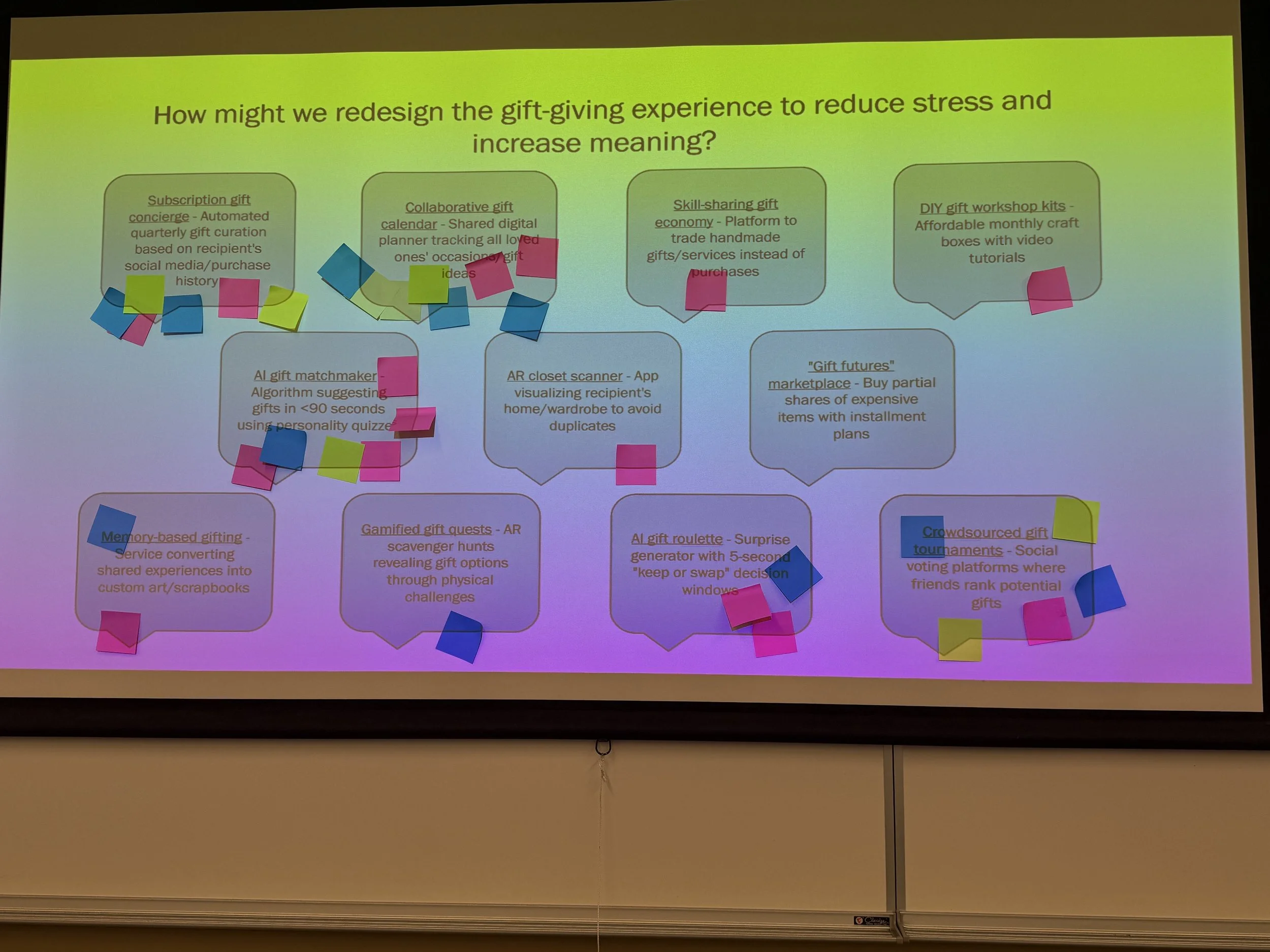
On teaching
I'm an adjunct professor at Nebraska Wesleyan University, where I teach Problem Solving and Design Thinking in the Innovation & Entrepreneurship program. Before that, I taught UX/UI Design at the University of Nebraska–Lincoln, and spent five years teaching Principles of Management and Organizational Behavior at the University of Nebraska at Omaha.
Teaching is not a side hustle or a credential; it's the thing that keeps my practice honest. You cannot successfully explain empathy mapping to a 19-year-old with a vague metaphor. You have to actually know what you're talking about.